Pages

Friday, October 23, 2020

CHARLES' THOUGHTS ON BIBLE READING -- Advice to a Friend

Charles wrote the following note to accompany a gift Bible sent to a friend.  After reading his message, I thought it was worth sharing with others, so I created this blog, and added a few illustrations and a short bio for Charles at the end.  I added a few comments in red, and ask you to please add your comments and opinions.  


Dear Friend:


I have heard that you have some questions about religion, heaven, hell, and salvation.  I first had those same questions when I was still in school.  I had been going to church since I was a baby, and over and over I heard the preacher say that you had to read the Bible.  When I joined that Church, I was given a small King James Bible.  I began trying to read that Bible.  It made no sense to me.  I would read the words and reread and read some more, and I just couldn’t understand where they were coming from.  All those “Thou shalt nots” and the “Begots.”  The words were like Greek to me.  I finally gave up on reading that Bible.  


I never stopped attending and taking part in church activities, and I picked up a lot from the sermons and Sunday school lessons, but I never read the Bible.  


       When I was about 48 years old, we were visiting our oldest daughter, and her husband.  We were staying in our granddaughters bedroom, and I couldn’t sleep.  I took a book from her bookshelf, to read myself to sleep.  It was a Children’s Bible.  I started reading her Bible and it made sense, and it was fun reading.  I realized that I was understanding the Bible and even enjoying it.  I began to feel better about not reading that King James Version.


Time passed, and Frances and I retired back to our farm and began new lives.  We were attending my hometown Methodist Church, where I had grown up, and been given that King James Bible.  My older brother, a retired teacher and football coach, was the pastor. We were active in the church, and one day my brother talked to us about the Methodist Church needing preachers for little rural churches. He said we had the qualifications and that we should consider going into the ministry.  I couldn’t tell him, but I felt unqualified because I had never read the whole Bible.  How could I be a minister if I had never read my Bible from cover to cover?  I was too ashamed to tell my pastor/ brother.


Well, Frances found an audio Bible in modern English, and I began listening.  I listened in the car when I drove, and I listened when I walked, and when I worked out at the gym.  I listened to the entire Bible.  


We listened to the audio version of The Message, (my favorite modern language version of the Bible.  Today there are many more options available, with dramatized versions as well as readings by famous actors and actresses.  Many are free, and they are available in many formats.  Check out these reviews, but know that new options appear daily


        After that, Frances and I accepted the call to the local minister’s program in the United Methodist Church.  In their training program, I studied and learned more about the scriptures.  But I have stayed interested in newer versions of the Bible that help me (and others like me) understand God better.  Every few years, another Bible scholar comes out with a new version of the Bible that makes it easier for more people to enjoy and understand the story of God’s love for us.  Each one seems to offer some new insight into the “Greatest Story Every Told.”


       I think there are lots of people all over the world who have guilty feelings about not reading the Bible.  I would like to tell them that it is not READING the Bible that is important; it is UNDERSTANDING the message of the Bible that is essential.  No one is ever saved by reading the Bible; they are saved by knowing the God and Savior that the Bible is written about.  One way to know God better is to read the Bible; but the essential way to know God is to feel His presence in our lives, to feel His Love, and to accept His Salvation.  Reading the Bible helps because the Bible tells us about

God, but the Bible is a means to an End, not a goal in itself.  Different people gain understanding in different ways from different experiences.  Recordings, Music, Movies, Songs, Poetry, Testimonies, Stories, Sermons are all means of achieving greater understanding.  There are different means for different people.  We have so many ways of seeking God; and no way is more perfect than another.  What works for you is the right way.
In my old age, I’m afraid my Bible reading happens mostly when I read to my great grandson at bedtime.  His Bible Storybook teaches the same message as that in King James Version, only it is better illustrated, more fun, and easier to understand.    I’m sending you a copy of a recent version of the Bible that I like very much.  It gives the essence of the Bible teachings with less redundancy (many books of the Bible tell the same stories in different formats), and reads in “normal” modern English.  We have included the audio version, because Frances and I both enjoy listening, and do that more often than we read.  If this version doesn’t work for you, I can suggest some others.


In addition to the Bible, I’m sending you a video sermon.  This minister preached a revival in our little church.  He stayed with us during the revival, and we were blessed by knowing him.  We thought you would enjoy hearing his testimony.


In Christian Love and Prayers,


A short Bio of the Author, Charles C. Freeman:

Charles Cleveland Freeman, Col., Retired, US Army Medical Core, holds an A.A. degree from Panola College, and  B.S. and M.S. degrees from Northwestern Louisiana State University.  He has completed post graduate studies at Memphis State University, UCLA, NYU, Baruch College of CUNY,  the U.S. Army Command and General Staff College, and the Harvard Kennedy School of Government.   In the course of his career, he has been a teacher and coach; a VAMC Kinesiotherapist; VA Research and Education Director for Prosthetics and Orthotics; Associate Director of VAMCs in Sheridan, WY, Chicago, Ill., and Dallas, TX; as well as Director of VAMCs in San Juan, P.R., Bonham, TX, and Alexandria, LA. In retirement he became a Local Minister of the United Methodist Church, serving in both the Texas and Louisiana Conferences.  His complete biography can be found at:  

http://communicatinglife2.blogspot.com/search?q=charles


Wednesday, September 23, 2020

LINDSEY L. HEARD -- A collection of Memories


Lindsey L. Heard, a direct descendant of the original pioneer settlers of Dry Creek, is King Beauregard Fair 2013. 


Lindsey Heard, Bernadine Johnson Heard, and Alton Heard


            Lindsey Heard is the youngest of 13 children, raised on a working farm in Pitkin. He is a veteran of World War II, having served three years in Europe under the command of Army General George S. Patton. Following his discharge, he and his former wife of 67 years, Bernadine Heard, made DeRidder their home. 

           Heard worked as a warehouse supervisor at Crosby Chemicals/Meade Westvaco, and he retired in 1987 after 42 years of service.  He has made numerous contributions to the Beauregard Parish Fair. For more than 20 years, Heard assisted County Agents, 4-H leaders and 4-H members, including his daughter and grandchildren, feed, groom and transport livestock to local, district and state competition and sales. 

            Heard is an avid gardener and yearly exhibitor of produce in the Ward 3 Fair Booth. His “Sugartown” watermelons win first prize on a regular basis. One of his greatest pleasures is giving away tomatoes, corn, peas and watermelon that he raised. Many friends and neighbors have been on the receiving end of his generosity. 


            Heard is an avid hunter and outdoorsman. At age 90, he still enjoys dove, duck, squirrel and deer hunting. In the fall he can be found many mornings on a deer stand in Pitkin or Brady, Texas, looking for another “big buck” to step out. 

            He is a member of First Baptist Church in DeRidder, Delta Waterfowl, American Legion Post 27 in DeRidder, Rosie the Riveter Association and Pitkin Lodge #338 F&AM. He also volunteers in assisting DeRidder Kisatchie Chapter Daughters of the American Revolution place flags on display during patriotic holidays at Beauregard Memorial Cemetery. 

              He has one daughter, Lydia Jane McLamore and husband Bob, two grandchildren, Gretchen Jane Levine and husband Colonel Mark Levine, Shane McLamore and wife Tara, five great-grandchildren, Sarah Jane and Lance Levine, and Carter, Cruz and Cane McLamore.


OBITUARY

           Services for Lindsey L. Heard, 94, of DeRidder, LA, will be held Wednesday, December 28, 2016, at 2 P.M. in the First Baptist Church in DeRidder with Rev.Lindsey Burns and Rev. Lynn Clayton officiating. Burial will follow in Beauregard Cemetery in DeRidder under the direction of Labby Memorial Funeral Home in DeRidder. 

          Mr. Heard passed away Monday, December 26, 2016, in his residence in DeRidder. Lindsey L. Heard, descendant of the original pioneer settlers of Dry Creek passed away December 26, 2016. He was the youngest of thirteen children raised on a working farm in Pitkin, Louisiana. 

          He is a veteran of World War Two, having served three years in Europe under the command of Army General George S. Patton. He was awarded the Purple Heart. 

         He worked as a warehouse supervisor at Crosby Chemicals/Mead Westvaco, and he retired in 1987 after forty-two years of service. In honor of his contributions to Beauregard Fair he served as King Beau Fair in 2013. He was an avid gardener. His “Sugartown” watermelons won first prize on a regular basis at the fair. One of his greatest pleasures was giving away tomatoes, corn, peas, and watermelons that he raised. Many friends and neighbors have been on the receiving end of his generosity. 

          Lindsey was a hunter and an avid outdoorsman. At age ninety-four he still enjoyed dove duck, squirrel, and deer hunting. In the fall he could be found many mornings on a deer stand in Pitkin or Brady, Texas, looking for another big buck to step out. He was a member of First Baptist Church DeRidder since 1947, Delta Waterfowl, American Legion Post twenty-seven in DeRidder, Rosie the Riveter Association, and Pitkin Lodge #338 F & AM. He also volunteered in assisting DeRidder Kisatchie Chapter Daughters of the American Revolution place flags on display during patriotic holidays at Beauregard Memorial Cemetery.

Heard Children on front Porch -- Seated are Francis, Vera, Addie, Burkett, Myrtis Lee, Simmie, Meredith, Glenn.  Standing are Lindsey and Alton


TWELVE TRICKS TO STOP STUTTERING

TWELVE TRICKS TO STOP STUTTERING:

And Some Insights Into Why

By 

Frances J. Freeman, Ph.D.

PART #1


Introduction

For over 50 years I was a clinician, researcher, and university professor with a primary clinical interest in stuttering.  I am author of a number of seminal research reports on stuttering, but I have never published on my clinical work, methods, or insights.  A recent entry in the FaceBook Group “Stuttering Community” intrigued me. The writer asked others to share any “Tricks” that could stop stuttering.  His request made me think.  I had spent 30 years teaching students of communications disorders my “tricks” for stopping stuttering; why shouldn’t I teach people who stutter these “tricks’? This series of Blogs is my response to this question.


The History of “Tricks” for Stopping Stuttering  


From Ancient Times — 

Recorded history chronicles many stories of the successful treatment or “healing” of stuttering by a variety of methods.  From at least the Middle Ages through the early 20th Century, Stuttering was primarily treated by men and women who have been called “stutterer-curers.”  Many were itinerants, moving from place to place, offering their cure at fair-market prices.  Some built “schools,“ and had students who came to them for treatment.  Most, but not all, guarded their “secret” treatments and made stutterers pledge never to reveal how they were cured.  One man who treated stuttering in the mid-19th century,  freely shared his approach.  James Hunt’s  writings on the nature and treatment of stuttering demonstrated wisdom that can still guide us. 


Modern Times —

With the scientific revolution, stuttering became a subject of interest in the developing fields of medicine, education, neurology, psychology, psychiatry, linguistics, and child development.  In the early to mid 1900’s,  leaders in the “scientific” study of stuttering rebuked all of the early treatments of stuttering, and coined the derogatory term “stutterer curers.”  The new experts concluded that the “curers” used “tricks” which stopped stuttering, but that these “tricks” lost their power over time, and the stuttering returned.  They considered the “curers” to be charlatans, cheats and “tricksters.” 


The prevailing theory held that the “tricks” worked because they served as “distractors.”  A “distractor” worked until it was  habituated, and then the stuttering returned.  In the view of that period, the “tricks” were ALWAYS temporary panaceas, and NEVER resulted in permanent cures.  This belief was based on reports from stutterers who relapsed after treatment.  However, systematic studies of success/failure rates for the “stutterer curers” were never conducted, so we don’t really know if some were permanently “cured” by their “tricks.”


During the mid 1900’s, stuttering treatments were developed that focused on recognizing, accepting, confronting, modifying, and managing stuttering.  Clinicians developed techniques that minimized overt stuttering, thus producing more fluent sounding speech. Stutterers learned to recognize when they were about to stutter, and to change or modify their speech in order to prevent uncontrolled or involuntary stuttering.  Voluntary stuttering, controlled stuttering, cancelations of “bad” stuttering by more fluent “easy” stuttering, soft contacts, easy onsets and other techniques were used to reduce struggle, tension, and overt stuttering.  These came to be known as “Stutter more fluently” treatments. For almost three decades (1930’s-1960’s), no reputable, professional in speech correction, speech therapy, or speech pathology (the three names used by the profession over those years) would use any of the forbidden “tricks.” 


Among the revolutions of the 1960’s was a rapid expansion of the hybrid field of Speech Science. The discoveries in this field led to much that we take for granted today, including (to name only a few) talking computers, Siri, Alexa, captioned TV, text to speech, speech to text, voice identification, and computer translators.  


Reacting to new knowledge from this emerging field, Marcel Wingate in 1969 and 1970, wrote two articles in which he reviewed the known “TRICKS” for stopping stuttering.  He called these  century-old “tricks”  “fluency evoking conditions.”  He didn’t exactly commit the heresy of saying that these “tricks” should be used in therapy; but he hypothesized that the scientific study of the “fluency evoking conditions” would be important in understanding the nature of stuttering, and possibly in developing better treatments.  


Through the 1970’s and the 1980’s a major movement in the field of stuttering focused on the study of the “fluency evoking conditions,” and eventually on treatments based in these speaking conditions.  As a group, these treatments were called “Speak More Fluently,” because they modified the overall speech pattern in order to produce less stuttering.  These treatments used one or more of the old “tricks” as basic “techniques” to induce stutterers to begin to speak without stuttering.  Then the treatments attempted to “shape” or “modify” the induced fluency to sound and feel like “normal,” “fluent” speech.  


The name also provided a contrast with the older treatment programs. As a result, clinical approaches were divided into:  “Stutter More Fluently” or  “Speak More Fluently.”  The Truth be Told, both approaches have basically the same efficacy results:  They help “Some Stutterers All of the Time; and Most Stutterers Some of the Time; but neither Approach helps All Stutterers All of the Time.”  


The lack of complete or perfect success for any behavioral treatment, has subsequently led many to believe that stutterers cannot learn to speak without stuttering, and that we must focus our efforts on changing attitudes and building acceptance of stuttered speech (among both the general public and stutterers).  The goal is to use knowledge, information, and understanding to remove any stigma or shame, and to promote acceptance of stuttering as  another “way of speaking.”  This approach has been facetiously labeled “Stutter More Happily.”


In the midst of the often violent conflict between advocates of these approaches, some clinicians have become eclectic or pragmatic.  They attempt to treat each stutterer as an individual who has specific needs, and who responds differentially to treatment.  Some of these clinicians have  many satisfied clients, but no general recognition of their methods or approach.  Specifically, the efficacy of individualized treatment is difficult to validate.  If each client receives a different treatment, the clinician can’t even demonstrate reliability?  These individualized approaches haven’t even rated a label.  


One thing that has remained constant across the years (ancient to modern) — no one has ever just given the “tricks” for stopping stuttering, and knowledge of why these work to the people who stutter, to let them discover for themselves if, which, when, where, for how long, and under what circumstances these “tricks” help them. 


THEREFORE, I have written this PART #1, and am posting a link to it on the FB GROUP.  If enough people read and respond I will write PART #2.  Specifically, I am asking:

  1. Are any of you interested in reading further?
  2. If you read more, and try any of the “tricks” will you write and tell us about your experiences (give feedback that can be used to help us learn and/or help others)?
  3. Will you view this not simply as a means of improving your own speech, but as participating in stuttering research to: 1). Learn more about your own stuttering and 2). Create new understanding of the nature of stuttering.

If I write more about Stuttering, I promise to end each segment with a true story about stuttering.  The first such story follows:


THE STORY FOR PART #1


How Johnny Stopped His Own Stuttering


As a very young public school speech therapist (we had not yet become Speech Pathologists), I worked with Johnny every Wednesday morning.  Johnny was 7 and in the second grade.  He was a brilliant child, and absolutely beautiful.  He read on a 4th grade level.  His language, vocabulary, and grammar were above average, and his articulation was perfect -- but he stuttered severely.  He prolonged almost every continuant sound, so that it could take Johnny a whole minute to complete a short, simple sentence. 


To try to type one of Johnny’s sentences would be like this:


 “MMMMMMMyyyyyyyyy nnnnnnnnaaaaamme iiiiiiiizzzzz Joooooooonnnnyyy.”  


    He never repeated a sound or syllable, and there was very little struggle or tension in his speech. 


Nothing in my training or in my reading prepared me to treat Johnny.  I read more; I talked to other clinicians; I called my former professors — I didn’t find an answer.  How was I supposed to help Johnny?  


Finally, one Wednesday morning, in absolute desperation, I asked Johnny: “Johnny, WWWWyyyy dooooo yyyyyoooouuu taaaaalk llllliiiiiik ththththiiisss?”


Johnny looked at me like I was crazy, and then said, “So-so-so-so I-I-I-I wo-wo-wo-won’t stu-stu-stu-stutter.”  


    Johnny had taught himself to prolong sounds to keep from repeating sounds. In Johnny’s mind, and according to his understanding, repetitions were stuttering, so he taught himself to prolong sounds instead of repeating.  Johnny believed he had cured his stuttering.


You will be happy to know that Johnny learned to talk without repetitions or prolongations, and that right after Christmas of second grade, he graduated from speech therapy.  Johnny taught me a lot about stuttering, but most importantly, he taught me to always ask the person who stutters to teach me what I need to know about his/her stuttering.

Saturday, July 4, 2020

HEARD FAMILY LETTERS Communications between Dry Creek Louisiana and Georgia

HEARD FAMILY LETTERS  

These Letters have been passed down through the Family of Zachary Taylor Heard, youngest son of John Thomas Heard, son of Jesse Holloway Heard.

Families In the Correspondence -- Berry; Heard; Hewell; Lindsey; Williams.  Please note, the letter images can be enlarged and enhanced by the reader.

LETTER --  1828 

This Letter is a Bill of Sale for Slaves, named in the letter.  It appears to be postmarked from Newton County, Georgia.  The purchaser is McCormick Neal.  The signature of the seller has been torn away.  The purchase price is $300.  It is possible that Jesse Holloway Heard was selling slaves in Georgia before leaving for Louisiana.  


LETTER --  1829

In this letter Susannah Taylor Berry (b. 1770 d. after Sept. 1829) the widow of William Wood Berry, living in Newton County, Georgia, wills a slave girl to her grandchildren, the children of her son Edmund Berry and his wife, Elizabeth.  This bequest is a bit puzzling since Susannah had 10 children, and a multitude of grandchildren.  She may have been living with Edmund and was very close to these children or she may have left similar bequests to other grandchildren.

LETTER --  April 2nd, 1847 --From Joe to J. W. Hewell, Written in Covington, GA.

I believe this letter is written to Jesse Wyatt Hewell (b. Oct. 12, 1793 and d. Sept. 24, 1852, 5 years after this letter was written), who was the father of Mary Susan Hewell wife of Jesse Holloway Heard.  However, the letter could be written to Susan's brother,  John Wesley Hewell.  Joe is an African slave who writes to deny a debt owed to J. W. Hewell.  The letter is written for Joe by a friend, whose signature I cannot read.

LETTER --  April 12, 1848 -- From Jesse Holloway Heard in Louisiana to his Father, James A. Heard (b.1776, d. 1857) and his Mother, Elizabeth Holloway Heard (b. 1779 d. 1855) inGeorgia.  In the letter he describes their grandsons John Thomas Heard, who is 2 and approaching 3, and James Hewell Heard, who is only two months old.  He tells them that John Thomas has blue eyes while James Hewell has dark eyes.  The grandparents will die in 6 and 8 years, never having seen these grandsons.


LETTER --  Dec. 14, 1850 This two page letter from Plaquemine Parish is a puzzle to me.  I think it is sent to Jesse Holloway Heard because the writing is not his.


LETTER --  April 19, 1857 : From Mary Susan Hewell, wife of Jesse Holloway Heard to her Mother, Martha Patsy Berry Hewell. 

I could really use some help in transcribing this very personal and touching letter.


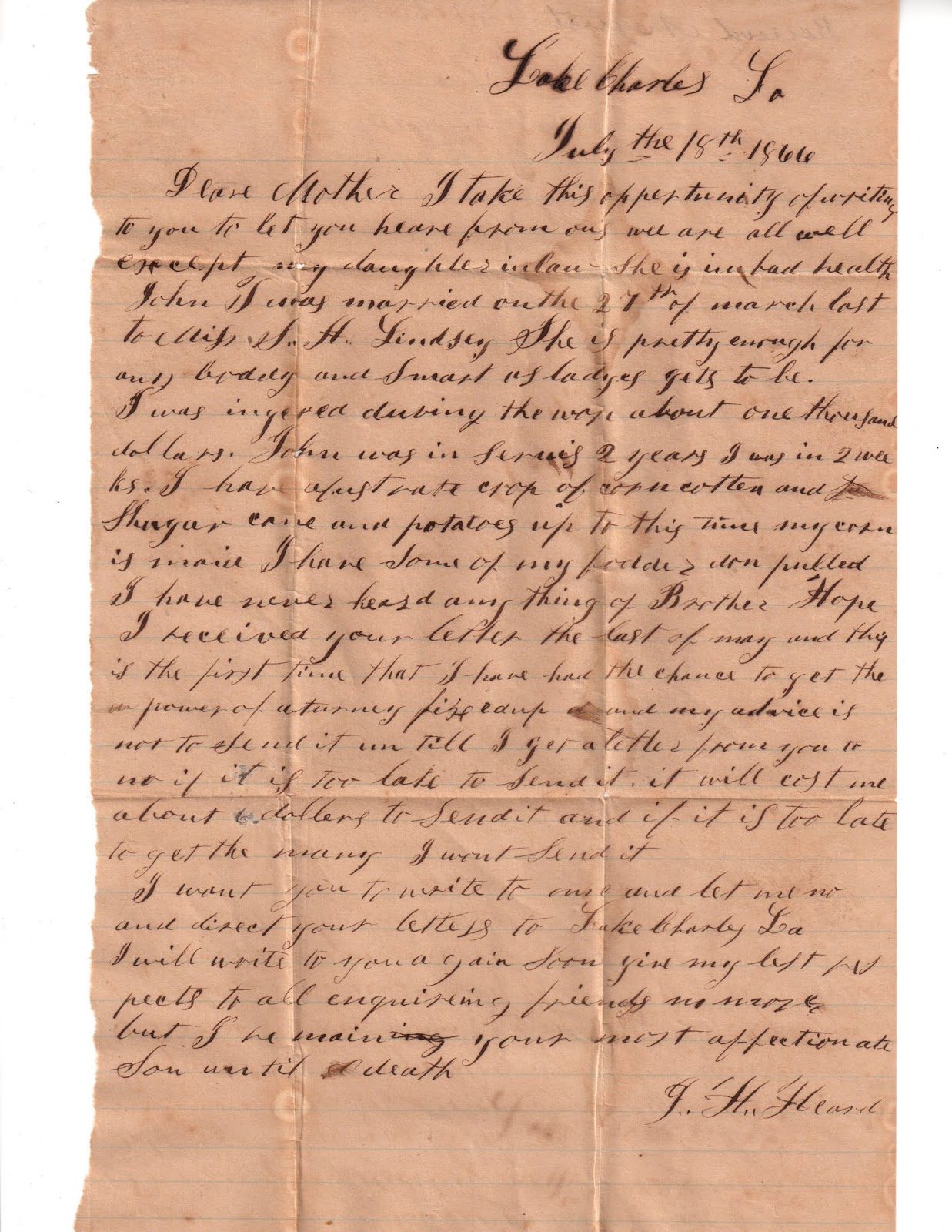
LETTER --  JULY 18, 1866

Postmarked -- Lake Charles, Louisiana 

From: Jesse Holloway HeardTo: Martha "Patsy" Berry Hewell (his Mother-in-Law)


THE LETTER


THE TRANSCRIPTION:


"Lake Charles, La.
July the 18th, 1866
Dear Mother, I take this opportunity of writing to you to let you hear from us. We are all well except my daughter-in-law. She is in bad health. John T. was married on the 27th of March, last to wife, S. A. Lindsey. She is pretty enough for anybody and smart as ladies gets to be.
I was injured during the war, about one thousand dollars [I do not understand this sentence]. John was in Service 2 years I was in 2 weeks.  

I have a first rate crop, of corn, cotton, and sugar cane and potatoes up to this time my crops is _____. I have some of my fodder pulled. I have never heard any thing of Brother. Hope [I don't know what was omitted here]

I received your letter the last of May and this is the first time that I have had the chance to get the power of attorney fixed up and my advice is not to send it until I get a letter from you to know if it is too late to send it. It will cost me about 6 dollars to send it and if it is too late to get the money I won’t send it. I want you to write to me and let me know and direct your letter to Lake Charles, La. I will write to you again soon.  

Give my best respects to inquiring friends. No more, but I remain Your most affectionate son until death.
J. H. Heard (Jesse Holloway Heard)

(I would offer three explanatory comments:  

First, John Thomas was in the siege of Vicksberg and was paroled, but fought again in the Battles of Mansfield and Pleasant Hill. Jesse Holloway fought only at the Batles of Mansfield and Pleasant, i.e. "John was in Service 2 years, I was in 2 weeks."

Second, the daughter-in-law, Sarah Adeline Lindsey is said to have lost a baby about the time of this letter, and this may be a delicate reference to her pregnancy or to her loss. She would give birth to William Crowder Heard the following July.

Third, I do not know who "Brother" is. This is not the only letter in which he asks about this "Brother.")


Thursday, July 2, 2020

The Parable of My Chicken Boy

THE PARABLE OF 
MY CHICKEN BOY
It was the fall of 1968.  I had just turned 28; I was a wife, mother of two daughters; and a fan of Elvis Presley and Daphne du Maurier.  I was in my 5th year as a public school speech therapist (that’s what we were called then).  The Caddo Parish schools were in their second year of integrating racially segregated schools.  Geographically, Shreveport, is the urban center of otherwise rural Caddo Parish (called county in the other 49 states, but Parish in Louisiana).  

In those chaotic times, I was actually working three jobs, but none of the job titles reflected my main task.  As unprepared as I was, I was acting as a cross-cultural linguistic anthropologist, struggling to help Black teachers and children understand White teachers and children, and vice versa.  Note, I am not primarily talking about spoken language.  As it turned out, non-verbal communication differences created more misunderstandings than verbal differences.

In the midst of this crazy period, I met my “Chicken Boy.”  In some strange way, this comic/tragic story remains vivid in my memory as a parable for the madness of the era.  Now, read to the very end, and pay attention, to the details because there will be a test.

I call him “Chicken Boy” or Chick for short, not to be callous, but because his “real” name was never fully established.  His adopted Mothers —and don’t get excited, in those unenlightened days, “Mothers” referred to the two women who raised him, a middle aged woman and her adult daughter —  had changed his name several times, and could not agree on what his “real” name should be.

I met Chick because one of my jobs was as an Audiologist/ Speech-Language Pathologist on a Pupil Personnel Evaluation Team.  We had four team members, including a Coordinator who was an Educational Specialist, a Psychologist, a Social Worker, and me.  Our job was to figure out what was interfering with each child’s progress, and to make recommendations to correct the problem (really simple, right?).  We were working our way through a backlog of referrals, but Chick came to us as an “emergency” case. 

Chick had just entered kindergarten, and was non-verbal; but being a five-year-old who didn’t talk did not constitute an emergency.  Rather, it was Chick’s persistent successes in escaping his teachers and running away that brought him to us.  The school hadn’t succeeded in restraining him, and they feared he would get into the street and be run over.  This was a real possibility since Chick was fast and fearless.  Our Educational Specialist had visited the school and gathered this information.  She offered no insights into Chick’s academic abilities, reporting that the teachers had not succeeded in getting him to sit in a chair.  He just sort of wandered around.  No one was sure if he could hear, or if he even understood speech.

Our social worker did a home visit and interviewed Chick’s mothers to collect his history.   His younger adopted Mother, was in the hospital for gynecological surgery when Chick’s biological Mother gave birth to him. During recovery, they shared a room.  Chick’s mother really didn’t want him, and his adopted Mothers thought that it would be really great to have a baby.  His birth mother just gave him to her roommate, and the new Mothers took him home.  There was never any paperwork or any of that legal stuff.  Chick’s adopted Mothers never heard from his birth mother again.

The Mothers had a little home in a rural area.  They raised yard chickens, and the yard was tightly fenced to keep the fowl safely inside.  They were very fond of Chick, and fed and clothed and petted him.  When he was annoying, they put him outside in the yard to play with the chickens.  They considered him a sweet, pretty little boy (and he was those things). I had the background, and thought I was ready to see Chick.

Before proceeding, I should tell you about the physical environment.  In case you are imagining a lovely clinic — forget it.  Our team operated on the third floor of a closed urban high school building.  It was a beautiful old building, but deteriorating, and less than desirable for our purposes.  I used a former classroom, with large, high windows, kept open to provide cooling ventilation since schools had no air-conditioning in those days

Chick was actually adorable.  He hopped into the room, and proceeded to explore the entire space, while clucking, cackling, and crowing.  His chicken noises were absolutely authentic, and seemed to match his mood and the discoveries he made as he explored the room.

After observing his behavior, I finally attracted his attention with a collection of toys and puppets.  He hopped around me for a while, and then climbed up on a chair, and sort of perched or squatted.  I worked to explore his receptive language, and established that not only could he hear, he understood words as well as the average 3 to 4 year old,  However, his comprehension of syntax and grammar was only at a 2 year old level.

By this time, Chick and I were friends, and he began to communicate with me.  He clucked, squawked, cackled, and pantomimed the things he wanted to tell me.  We were having a great time.  Chick began to run around and around the room, flapping his arms wildly.  Then, before I could react, he leaped up on a desk, and from the desk top, I swear, he flew, flapping his arms and going up, up to the wide sill of the big open window.  There he perched, alternately looking back at me, and then down three floors to the ground and parking lot below.  As I watched, terrified and open-mouthed, he strutted back and forth along the window sill, crowing loudly and flapping his arms.  

There was nothing wrong with Chick’s social perceptions.  He knew he had me.  If I approached him, he moved toward the edge of the window, as though preparing to fly.  He watched me closely, obviously wanting to see what I would do, and how much fun he could have with me.

“Oh, My God,” I prayed.  “Please help me.” And that was a real prayer.  I tried to talk to Chick, but he ignored me.  Then I tried clucking, and that sort of fascinated him.  He stopped pacing the sill to look at me.  I tried clucking and crowing, and he laughed at me.  Suddenly, my panicked brain focused on my “bag of tricks,” my collection of things I used to engage children.  There, among the toys, and magic tricks, and puppets, were two potential saviors — a chicken puppet and candy. 

I grabbed the chicken puppet, and began pretending she was eating the candy.  I ignored Chick, concentrating on the chicken clucking and pecking at the candy.  Out of the corner of my eye, I could see him watching.  When he was certain I was no longer was interested in him, he leaned further into the room to see what I was doing.  I held one of the candies up and then popped it into my mouth.  Chick leaped from the window, flapping his arms, and landed with a clunk beside me.  I grabbed and embraced him, and he was delighted, clucking warmly in my ear as I clutched him tightly to my breast, tears of thanks forming in my eyes.  In my delight, I fed him the entire box of candy corn.

The ending is relatively happy.  All Chick really needed was time with children instead of chickens; and we recommended that along with a fenced-in playground for his kindergarten class. (Wonder how that would read on a modern IEP?)  Chick would never be a an academic whiz, but he became a happy boy instead of a happy chicken, and grew up to be an exceptional basketball player.  He really did seem to fly on the court.

AND NOW, DEAR READER, FOR YOUR TEST — If you have been imagining Chick as Black, think again, and see him as White, and ask yourself what biases caused you to assume he was Black?

Wednesday, July 1, 2020

SARAH ADELINE LINDSEY AND THE PANTHER


The Lindsey’s were a pioneer family whose farm backed that of the Jesse Holloway Heard family. Both families were among the earliest settlers of Dry Creek Community, arriving there in the early 1800’s. The Heards came from Georgia and the Lindsey’s from Kentucky by way of Arkansas.  

When John Thomas Heard went off to fight in the Civil War, he went with his 3 year older neighbor, Asbury Monroe Lindsey. The 2 men endured the Siege of Vicksburg together before returning home. After the end of the War, John Thomas married his neighbor (and Monroe’s Sister) Sarah Adeline Lindsey. In the aftermath of the War, times were hard in Louisiana. One fall day (year not known), Sarah Adeline left her home (the Heard log home that stood until the 1980’s) early and rode the family’s big black saddle horse over to her parents’ home to help them butcher a yearling bull. She worked all day at the hard and bloody job. In the late afternoon when she was ready to go home her Dad, Burkett, strapped a fresh hind quarter of beef across the horse behind her saddle, and her mother put the beef liver (as a treat to be cooked for the babies) in a leather bag that hung from the saddle horn. They started home through the bottom land along the creek. Big pines had not been completely cleared behind the fields, and along the creek it was heavily wooded with hardwoods — oaks, sweet gums, hickory, chinquapins. The big trees in the swampy bottom made it dark and cool and shady and very quiet. The horse was nervous snd skittish and Sarah Adeline didn’t know why until she heard a strange cough sound behind her. The horse jumped and almost threw her and she looked behind and saw a big panther on the limb of a big oak. She kicked the already frightened horse and he ran breakneck down the twisting trail through the trees. Sarah Adeline knew she could cut the side of beef loose and the big cat would stop to eat, but she was too stubborn to give up the food her family needed. Instead, she whipped the horse with the reins and prayed he didn’t step in a hole. Behind her, she could hear the panther gaining on them. When the horse burst out of the woods and into the Heard fields, the cat was on the horse’s heels. Sarah Adeline began screaming for her husband, who heard the noise and grabbed his gun. As his wife raced across the field, he took aim and shot at the panther behind her. He didn’t hit the big cat, but the noise was enough to frighten it. Before he could reload, the cat disappeared into the woods. As the story was told the panther was black, but zoologists swear that there were no black panthers in the region, and that the legendary black panthers of the southern swamps were actually golden or spotted. When the story was told, Sarah Adeline was described alternatively as either brave or stubborn or both. The honor her family accorded her can be noted by the numbers of her descendants who are named Sarah, or Adeline, or Lindsey.


Sunday, June 7, 2020

THE HISTORY OF THE NOLEN FAMILY OF LOUISIANA

The Ancestors and Descendants of Absolom Simeon and Obedience Wise Nolen 

 * This Post is a follow-up to a Post in which we relate the Murder of Absolom Simeon Nolen and the trials and tribulations Obedience Wise Nolen survived.  You may want to read the earlier post first:  https://communicatinglife2.blogspot.com/2020/06/murder-on-ten-mile-creek-saga-of.html   (Click on the highlighted text to find the links)


A Summary of the Nolen Genealogy with Degrees of Certitude: 

Oral traditions and written records are the "stuff" of "traditional" genealogy, and constituted the sole basis for family histories until the 21st century.  However, within the last two decades, a second source of genealogical information has emerged, and begun to supplement and expand "traditional" genealogy.  At this time, we are still stumbling forward, struggling in our efforts to probe the potential of "genetic genealogy." However, we are gradually learning to use a range of genetic tests to clarify, support, or refute the findings of "traditional" family history research.  

I come from a long line of family historians, and have worked with "traditional genealogy" for over 50 years.  Since 2010, I have been intrigued by the potential of "genetic genealogy". That year my nephew did a Y-DNA test, which identified 10 generations of our Jackson family.  Miraculously, the puzzle we had worked on for over 30 years was solved. 

Recently, I wrote a brief introduction to genetic genealogy, hoping to encourage more of my family to participate.  If you are unfamiliar with genetic genealogy and how the different DNA tests can be used, it is a good place to start.


Summarizing Our Nolen Family History:  In the Nolan genealogy, presented in detail here, we show 7 generations  back from my generation (3 generations back from Sim Nolen).  We have great confidence in these data. This high degree of certainty, exists because we have multiple written records (documentation) and Autosomal DNA results linking my cousins and I to other descendants of a single Nolen Ancestor and his wife.  

They are Stephen Noland/Nolen, Sr. (who was born 1682 in Cecil, Charles, Maryland and died March 7, 1732 in Charles Maryland) and his wife Mary O'Bryan Connell (b. 1865 in Charles, Maryland & d. 1747 in Charles, Maryland).  The DNA matching of living descendants of the same ancestor is sometimes called triangulation.

Does this absolutely PROVE we are their descendants?  NO, because multiple families could have identical errors in their genealogies -- BUT every separate line that is connected by DNA makes the probability of an error lower, and the likelihood of accuracy, greater.  We can connect with confidence to Stephen (1682) and Mary(1685), but no further, because 7 generations is typically as far as it is possible to go using only Autosomal DNA.

As it turns out this Stephen (1682) was probably the first of our Nolen line to be born in North America; his father came from Ireland.  We have documentation, with some blanks and some contradictions   for 3 additional generations, taking us back to late 16th century Ireland.  For these generations, the evidence is reasonable, (that is, more likely than not) but far from absolute.
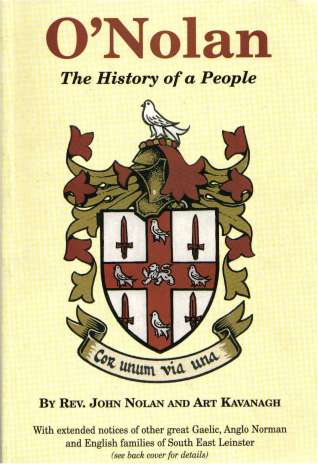
Historical genealogy of the Nolen Family
 of  Ancient Ireland published in 2000,
$39.95 on Amazon

For an additional 8 generations, back to the 14th Century, and our proposed ancestor Eocha Oge Nuallain (b. in 1385 in Carlow, Ireland and d. in 1435 in Carlow, Ireland) we have an "historical" genealogy which has been passed down for many generations.  Direct evidence supporting all, or portions, of this genealogy is lacking, and the best we can estimate is that this linage is possible. 

The method by which we could verify the proposed Nolen Genealogy, going back 18 generations and over 600 years is Y-DNA. In fact Y-DNA testing of Nolen Males has the potential for taking our knowledge of our Nolen ancestry even further back into the mists of legend and prehistoric Ireland.


Out of the Mists of Legend
With the Spotlight of Y-DNA

For many years, I have resisted including the legends of the NOLEN CLAN as part of my family history.  And this has been difficult, because the Nolen Mythology is absolutely the BEST.  But I was resolved to keep my genealogy as factual as possible, and the remote past WAS impossible to prove.  

Well, that was once true, but it is no more.  In fact under certain circumstances we can be more positive of our ancient roots than of our immediate kin.  We have moved into the era of genetic genealogy, and new avenues of investigation are available.  

 And I won't be shy -- I AM LOOKING FOR NOLEN MEN interested and motivated to do Y-DNA testing to determine which Nolen Linage we are descended through, and whether we are indeed descendants of Niall Nolgiallach (often called Niall of the Nine Hostages), the great King of Ireland.  
Modern Depiction of King Niall o Ireland

If you are unfamiliar with the legends of Niall, you are in for some great fun.  For a first look at the stories of Niall, I recommend: https://bardmythologies.com/niall-of-the-nine-hostages/.  OR

In fact, you can watch any of a large number of videos on You Tube.  Just search for videos on Niall.  Niall and Irish history/mythology is currently a very hot topic.  I really love the story that Niall won his kingdom because he was willing to kiss a withered, ugly, old hag.  

When you are ready for factual information, you may want to try any number of serious books, films, and lectures on Niall.  A good start would be: https://en.wikipedia.org/wiki/Niall_of_the_Nine_Hostages 

Most histories place Niall in the 5th Century A.D., using the year 400 as an estimated date of his birth.  However, some experts believe the "historic" Niall lived much earlier.


In recent years, the Y-DNA of Niall has become rather famous, and a bit controversial.  Y-DNA is passed down from Father to Son, for generations.  Specific mutations can identify different lines, while commonalities can be used to trace back hundreds, even thousands of years.  This approach has been used in Y-DNA mapping studies in Ireland. Interesting results have emerged related to surnames associated with Niall (including O'Niall/Niel/Neal and O'Nolan/Nolen/Noland). The O' means "son of" and indicates the sons of Niall. Nolen/Nolan is the English version of "Nolgiallach," so these surnames, as well as several of others, are associated with Niall.


Y-DNA studies of Irish men  identified a particularly fertile "Father" who apparently has at least 2 to 3 million male descendants scattered around the world.  In the northwest of Ireland 1 in every 5 men (21%) are his direct descendants.  This prolific Celt was the Irish equivalent of  Genghis Khan, who is the presumed "Father" of millions of men in Asia.  

Based on statistical data used to estimate the time period for the life of the Irish "super father," researchers hypothesized that he was the legendary, High King, Niall Nolgiallach (i.e. Niall Nolan).  Revised estimates for the age of the "super father" suggest that he lived at least a couple of hundred years before the time period usually allotted to Niall (5th Century).   These findings, if sustained, would make the "super father" Niall's grandfather or 2nd or 3rd great grandfather.

Y-DNA STUDIES OF NOLEN MEN --  Not only is there great interest in Y-DNA studies in Ireland, but in Texas at the laboratories of Family Tree DNA (where most Y-DNA studies are done), there is an active Nolen/Nolan Surname project, with considerable information on the various Nolen Lines. This Nolan Surname Page shows Y-DNA profiles for four Nolen Family linages, tracing each to a location an ancestor.  If some of our Nolen Men are tested, we can identify the linage of our Nolen Family and know where we originated in Ireland.  This page gives an overview of the Nolen Y-DNA and history.

More specific information about all of the Nolen's participating in the Family Tree DNA Surname Project is given on the official Family Tree Nolan Surname Project page.  If you look for the name "Pierce Nolen/Nolan" as the earliest known ancestor of the man being testing, you will find that Pierce (our presumed ancestor) actually appears in two different groups, the Carlow Nolen's and the Tipperary Nolen's.  Test results from our Nolen Men can tell us which of these groups matches our family, and where we lived in Ireland.  
Distribution of Y-DNA Haplogroup R-M269

Interestingly, both of these Nolen linages are part of the same Haplogroup -- R-M269.   Also known as R1b1a1a2, this group is a sub-clade of  human Y-chromosome haplogroup R1b. The mutation on R-M269, which identifies this Haplogroup, occurred in a single man between 4,000 and 10,000 years ago.  By the 2010 population count, he had about 110 million male descendants in Western Europe.  Eighty-two percent of men of Irish descendant belong to this Haplogroup.


OUR NOLEN GENEALOGY AS OF 2020